Review Process
Our rigorous double-blind peer review process ensures quality and integrity
Article Review Stages
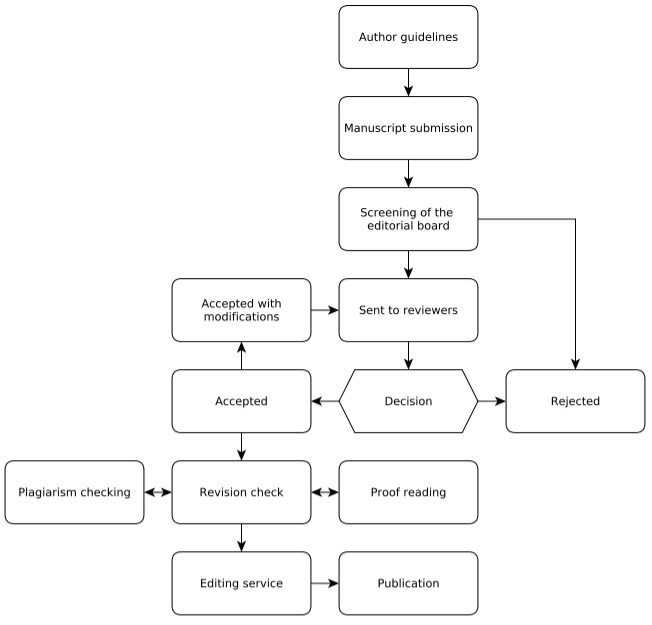
The review process follows four sequential stages to ensure quality, relevance, and ethical rigor.
Initial Screening
Editors evaluate every submission for compliance with the journal's formal criteria and completeness before it proceeds.
Suitability Check
The Editor-in-Chief confirms the manuscript fits the journal's thematic focus and assigns a handling editor.
Double-Blind Peer Review
Passing manuscripts enter double-blind review. At least two external reviewers evaluate each paper within 4–6 weeks of invitation.
Decision & Publication
Editors synthesize reviewer feedback and recommend outcomes to the Editor-in-Chief, who schedules accepted papers for publication.
Before accepting an invitation to review, every reviewer must declare any potential conflict of interest—financial, professional, personal, or a recent collaboration with the authors. If a conflict arises, the reviewer is replaced to ensure an independent and objective evaluation.
Editors are responsible for preventing such conflicts and safeguarding the impartiality of the double-blind process at every stage.
All reviewers fill out a standardized form with clear criteria. Free-form comments are encouraged, but final recommendations must be selected from the following:
- • Accept in present form
- • Accept with minor revisions
- • Reconsider after major revision
- • Reject
The expected timeframe for completing each review is typically 4–6 weeks from the date the reviewer is invited.
When reviewer reports diverge substantially—for example, one recommends acceptance and another recommends rejection—the editor may request a third independent report.
The Editor-in-Chief makes the final decision after considering all available reviews and the thematic alignment of the paper.
Articles that receive favorable reviews are analyzed in relation to their thematic focus. Editors provide recommendations to the Editor-in-Chief, who determines the final issue and section for publication.
Manuscripts that do not meet the journal's requirements at any stage are informed of the decision along with constructive feedback when available.
Fair and Objective Evaluation
Your manuscript will be evaluated solely on its scientific merit, originality, and contribution to the field.
Constructive Feedback
Reviewers provide detailed, constructive feedback to help improve your research, regardless of the final decision.
Transparent Outcomes
Every manuscript receives one of the four standard outcomes (accept, minor revisions, major revisions, reject) along with actionable comments.
Independent Evaluation
Double-blind review and conflict-of-interest checks ensure that every manuscript is judged solely on its scientific merit.
Right to Clarification
Authors can request clarification on editorial decisions by addressing reviewer concerns and providing additional context.
Visual summary of the CACTUS review workflow.
Ready to Submit Your Research?
Review our submission guidelines and start the process today